

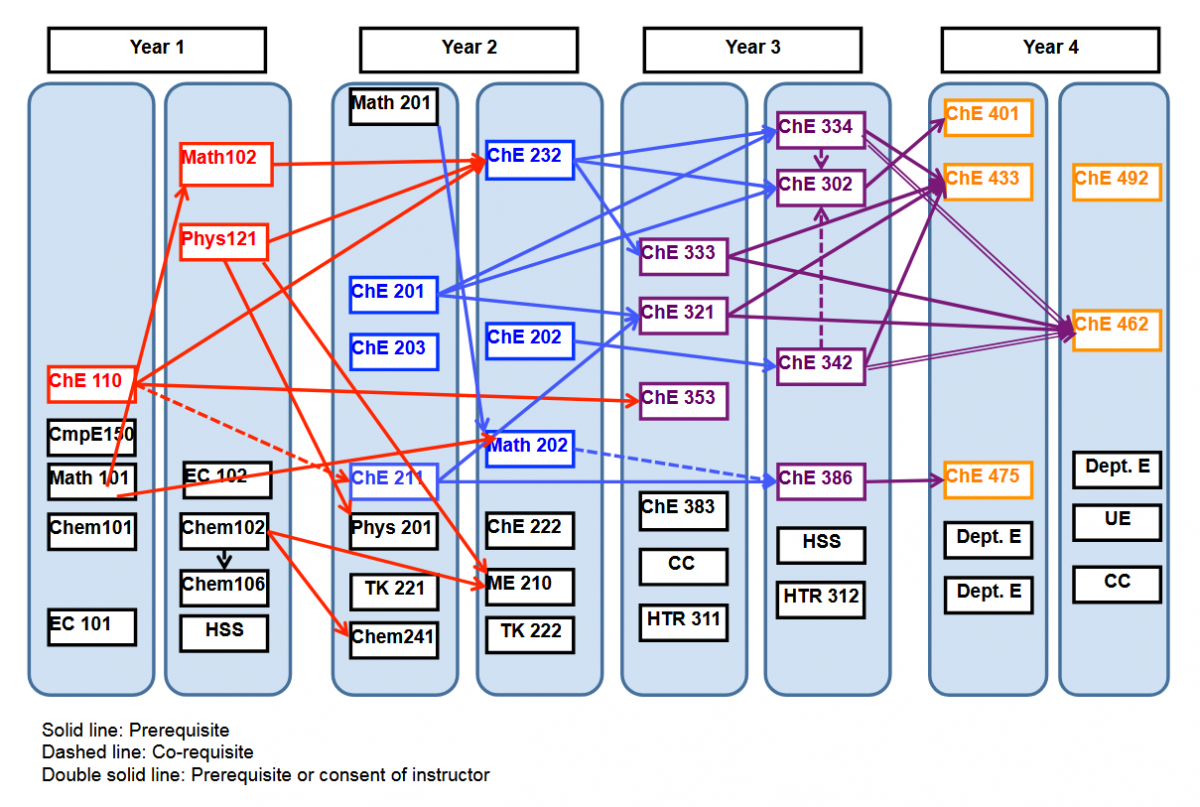
Chemical Engineering Undergraduate Program
| Credit | ECTS | ||||
|---|---|---|---|---|---|
| CHE 110 |
Intro.Chem & Biosystems Eng. Introduction and history of chemical and biochemical engineering. Chemical industries and industrial biotechnology applications in Turkey. Principles and applications of material balance calculations of continuous steady-state processes. Introduction to process flowsheet simulation, computational techniques and software applications. Introduction to chemical engineering design and economics. |
3 | 3 | 5 | 5 |
| CHEM 101 | General Chemistry I | 3 | 3 | 7 | 7 |
| CHEM 106 | Gen.Chem.Lab.* | 2 | 2 | 4 | 4 |
| CMPE 150 | Intro. to Comp. | 3 | 3 | 5 | 5 |
| EC 101 | Princ. of Microecon. | 3 | 3 | 6 | 6 |
| MATH 101 | Calculus I | 4 | 4 | 6 | 6 |
| 18 | 18 | 33 | 33 |
| Credit | ECTS | ||||
|---|---|---|---|---|---|
| CHEM 102 | General Chemistry II | 3 | 3 | 6 | 6 |
| EC 102 | Princ. of Macroecon. | 3 | 3 | 6 | 6 |
| MATH 102 |
Calculus II cvbcvbvcbcvb |
4 | 4 | 6 | 6 |
| PHYS 121 | Intro. to Mech. & Thermo. | 4 | 4 | 8 | 8 |
| HSS | Hum.Soc.Sci.Elective | 3 | 4 | 5 | 5 |
| 17 | 18 | 31 | 31 |
*Chem 106 may be taken either in the first semester or in the second semester.
| Credit | ECTS | ||||
|---|---|---|---|---|---|
| CHE 201 |
Physico Chem. Sys. I Description of physicochemical systems. Laws of thermodynamics. Changes of state. Solutions and phase equilibria. Chemical equilibrium. Physical chemistry of surfaces. The kinetic theory. Electrochemistry: conductance and ionic reactions; electrochemical cells. |
3 | 3 | 5 | 5 |
| CHE 203 |
Physicochem Sys.Lab.** Experimental techniques and analysis of data in physicochemical systems. Experiments related to the properties of pure gases, liquids and mixtures, phase diagrams, electrochemistry, rate of chemical reactions and catalysis. |
1 | 1 | 2 | 2 |
| CHE 211 |
Mass and Energy Balances Calculation methods used in chemical and biochemical engineering based on principles of material and energy balances. Application of equations of state, heat capacity, enthalpy, chemical reactions, two-phase systems, enthalpy-concentration diagrams, heats of solution crystallization, vaporization, melting etc. Simultaneous material and energy balance calculations of chemical and biochemical engineering unit operations, unit processes and related applications. |
4 | 4 | 5 | 5 |
| CHEM 241 | Organic Chemistry for Engineering and Life Sciences | 4 | 4 | 6 | 6 |
| MATH 201 | Matrix Theory | 4 | 4 | 5 | 5 |
| PHYS 201 | Physics III | 4 | 4 | 6 | 6 |
| TK 221 | Turkish I | 2 | 2 | 3 | 3 |
| 22 | 22 | 32 | 32 |
| Credit | ECTS | ||||
|---|---|---|---|---|---|
| CHE 202 |
Physico Chem.Sys.II Concepts and methods of statistical thermodynamics. Distribution of molecular states. Schrodinger equation, partition functions, X-ray diffraction. Electric and magnetic properties of molecules. Structure and motion of fluids. Radial distribution functions. Intermolecular forces. Kinetics of gases, diffusion equation. Chemical kinetics, rate laws, temperature dependence of reaction rates, elementary and complex reactions. Eyring's theory. Laboratory experiments. |
3 | 3 | 4 | 4 |
| CHE 222 |
Intro. to Biosystems Introduction to the molecular biology of the cell. Cellular metabolism, metabolic, regulatory and signalling networks. Bioinformatic tools and data banks. Systems biology approach to design problems in biotechnology . |
3 | 3 | 4 | 4 |
| CHE 232 |
Fluid Mechanics Dimensional analysis with applications. Fluid statics and its applications. Integral and differential mass, energy and momentum balances. Laminar and turbulent flow of Newtonian fluids. Flow measurements. |
3 | 3 | 5 | 5 |
| MATH 202 | Differential Eq. | 4 | 4 | 7 | 7 |
| ME 210 | Material Science | 3 | 3 | 5 | 5 |
| TK 222 | Turkish II | 2 | 2 | 3 | 3 |
| 18 | 18 | 28 | 28 |
**ChE 203 may be taken either in the third semester or in the fourth semester.
| Credit | ECTS | ||||
|---|---|---|---|---|---|
| CHE 321 |
Chem. Eng.Thermodyn. The laws of thermodynamics, equations of state and formulation of thermodynamic properties of systems. Generalized state properties. Prediction of behavior of multiphase and multicomponent systems. Chemical reaction equilibria. Thermodynamic analysis of processes. |
4 | 4 | 7 | 7 |
| CHE 333 |
Heat Transfer Heat transfer by conduction. Heat transfer by convection in single phase systems and in systems with phase change. Radiation heat transfer. Analytical, numerical and graphical techniques. Heat exchange equipment and networks. |
3 | 3 | 5 | 5 |
| CHE 353 |
Chem.and Biochem. Processes A survey of various processes in chemical and biochemical industries in light of probable future developments. Critical analysis of chemical and biochemical processes with discussions on environmental and process safety. |
3 | 3 | 5 | 5 |
| CHE 383 |
Prob.Stat.in Chem. Eng.App. Fundamental concepts in probability; probability distributions, mathematical expectations; statistical methods including sampling distributions, point and interval estimation, hypothesis testing, linear regression, analysis of variance, as applied in chemical engineering problems. Factorial design of experiments. |
3 | 3 | 5 | 5 |
| HTR 311 | Hist. Of.Turkish Republic I | 2 | 2 | 3 | 3 |
| CC | Complementary Course | 3 | 4 | 5 | 5 |
| 18 | 19 | 30 | 30 |
| Credit | ECTS | ||||
|---|---|---|---|---|---|
| CHE 302 |
Chem. Eng. Lab. Safety assessment. Principles of safety regulations. Survey of experimental methods. Series of experiments related to unit operations and unit processes. |
3 | 3 | 5 | 5 |
| CHE 334 |
Mass Trans.Operations General and special forms of the differential equations for mass transfer. Steady-state molecular diffusion. Convective mass transfer: single-phase and interphase transfer. Continuous and stagewise contacting of immiscible and partially miscible phases: gas absorption, desorption and liquid-liquid extraction. Distillation of binary mixtures. |
4 | 4 | 6 | 6 |
| CHE 342 |
Reac.Kin.and Reac.Design Kinetics of homogeneous reactions. Analysis of simple and complex rate equations; correlation of rate data. Kinetics of heterogenous reactions. Global rates. Isothermal and non-isothermal operation of homogeneous reactors: ideal batch, plug-flow and stirred-tank reactors. Other reactor types. Deviations from ideal performance. Runaway reactions. |
4 | 4 | 6 | 6 |
| CHE 386 |
Modeling and Optimization Mathematical modeling of steady-state and dynamic chemical engineering systems. Numerical solution of algebraic and differential equations. Basic optimization theory and algorithms with applications to chemical engineering problems. Process simulation techniques. Computer programming with Matlab. |
3 | 3 | 5 | 5 |
| HTR 312 | Hist.of Turkish Republic II | 2 | 2 | 3 | 3 |
| HSS | Hum. Soc. Sci. Elective | 3 | 4 | 5 | 5 |
| 19 | 20 | 30 | 30 |
| Credit | ECTS | ||||
|---|---|---|---|---|---|
| CHE 401 |
Chem. Eng. and Biotechnology Lab. Continuation of CHE 302. Series of independent laboratory projects and presentations and proposals related to fluid flow, heat and mass transfer, and chemical reactions in chemical engineering as well as enzyme reactions and fermentation in biotechnology. |
3 | 3 | 6 | 6 |
| CHE 433 |
Des.of. Chem. Proc. Units Basic engineering concepts, ethics and standards, and accepted procedures as applied to the safe design of main process units and auxiliary equipment. Understanding of potential process hazards and their incorporation into equipment and process design. Operating principles of chemical processing units. The analysis, specification and design of equipment and processes as these relate to the most recent health, safety and environmental regulations. |
3 | 3 | 8 | 8 |
| CHE 475 |
Proc.Dyn. And Control Dynamic modeling of linear and nonlinear chemical processes. Linearization. Laplace transforms. Stability of systems. Conventional feedback controllers. Dynamic behavior of feedback controlled systems. Controller design using frequency response techniques. Computer simulation of controlled and uncontrolled systems. Design of controls using simulation programs. |
3 | 3 | 6 | 6 |
| ChE-- | Departmental Elective | 3 | 3 | 5 | 8 |
| ChE-- | Departmental Elective | 3 | 3 | 5 | 8 |
| 15 | 15 | 30 | 36 |
| Credit | ECTS | ||||
|---|---|---|---|---|---|
| CHE 462 |
Plant Design and Economıcs Study of fundamental concepts in safe and environmentally benign chemical plant design. Organization of chemicals manufacturing plants and the economic considerations associated with the investment, feasibility and operation of such plants. Independent and group projects covering the above topics related to the existing local conditions. |
3 | 3 | 7 | 7 |
| CHE 492 |
Project Listed under Engineering Core Courses. |
4 | 4 | 8 | 8 |
| ChE-- | Departmental Elective | 3 | 3 | 5 | 8 |
| -- | Unrestricted Elective | 3 | 4 | 5 | 5 |
| CC | Complementary Course | 3 | 4 | 5 | 5 |
| 16 | 18 | 30 | 33 |
